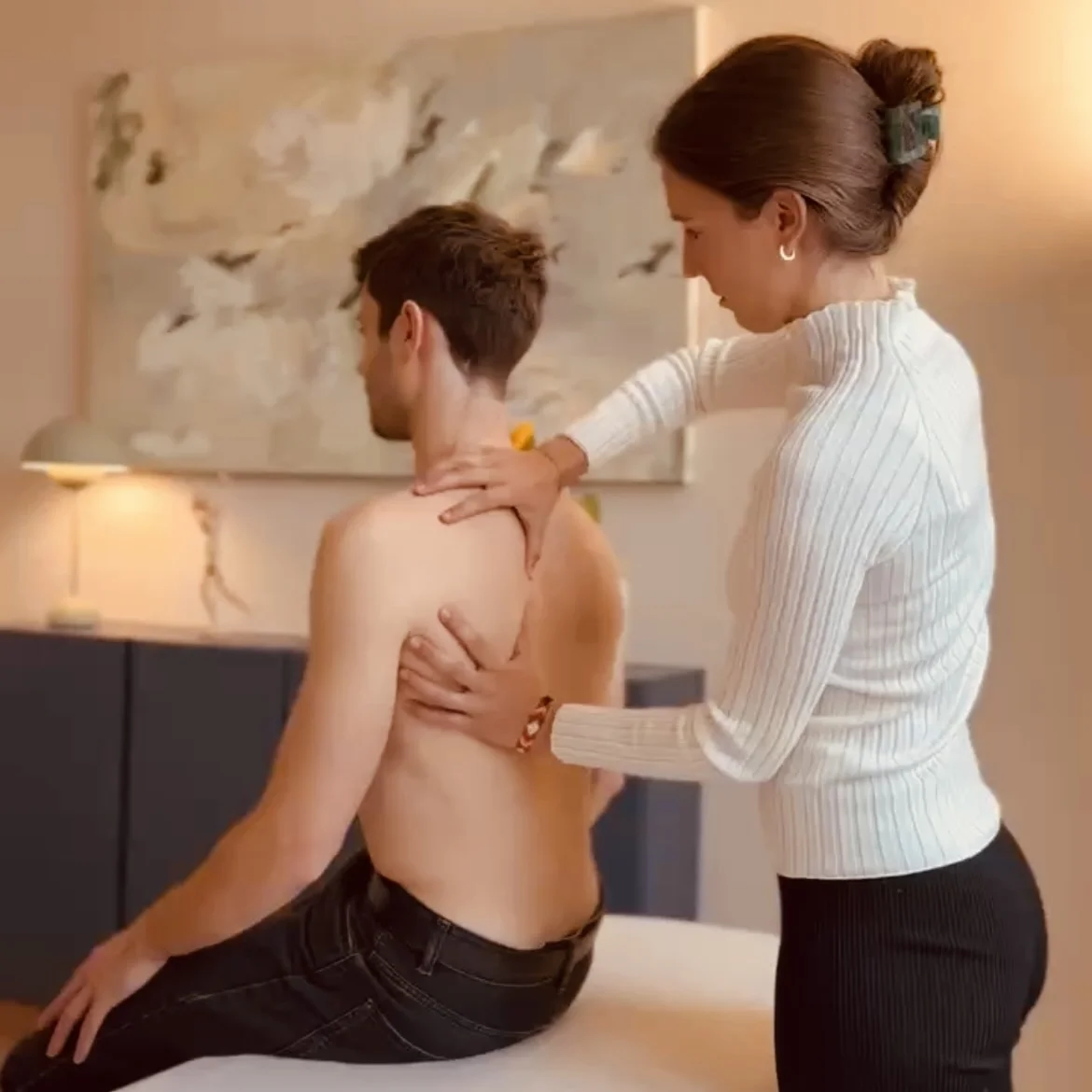
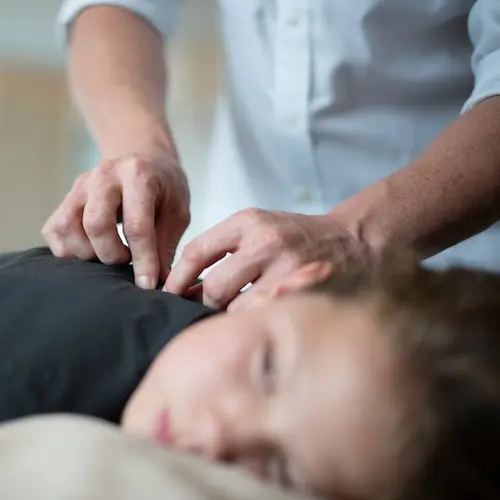
Osteopathy is a holistic, manual therapy that views the body as a unit. It aims to identify functional disorders and use targeted techniques to improve mobility and the interaction of body systems in order to promote health.
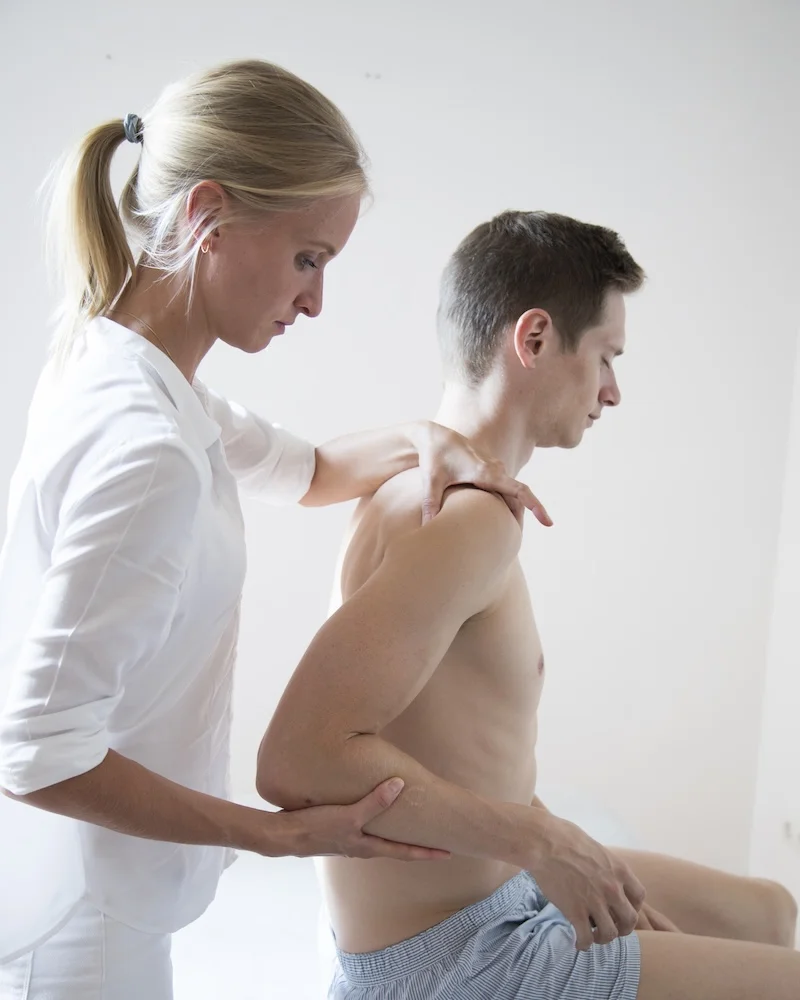
Every treatment begins with a detailed conversation. We talk about your current complaints, their history and your medical background. Previous injuries, operations or everyday stressors may all play a role. This gives us a holistic picture – because the root cause is often not where the pain is felt.
2
Examination – Getting to the Root Cause
A thorough osteopathic examination follows. With trained hands we assess joint mobility, tension in the muscular and fascial system, and possible functional restrictions in the organs. We treat the body as a functional whole to identify the underlying causes of your complaints.
3
Treatment – Individual & Holistic
Based on the history and examination, we develop a treatment tailored to your individual needs. Depending on the findings, different osteopathic techniques are applied – including musculoskeletal work, visceral techniques to support organ mobility and craniosacral approaches.
4
Aftercare – Lasting Improvement
After the treatment we discuss how your body may respond and what to be aware of in the coming days. You will receive individual recommendations to support your recovery as well as guidance on suitable treatment intervals. Some complaints improve immediately, others need a little time to regulate. Our goal is not just short-term relief, but lasting improvement of your condition.
Areas of Application – Osteopathy
How Can Osteopathy Help You?
Back & Neck Pain
Blockages, tension or poor posture in everyday life
Osteopathy identifies the root cause of your complaints – not just the pain point – and treats the full interplay of muscles, fascia and joints.
Disc Problems & Herniation
Pressure on nerve roots due to disc bulge or herniation
Osteopathy relieves pressure on affected structures, improves spinal mobility and can support the healing process in disc conditions.
Headaches & Migraine
Tension in the neck, skull or temporomandibular joint
By releasing tension in the structures around the skull, cervical spine and jaw, osteopathy can significantly reduce the frequency and intensity of headaches.
Shoulder Pain & Shoulder-Arm Syndrome
Tension, impingement or misalignment in the shoulder-neck area
Through targeted mobilisation of the shoulder joint, ribs and cervical spine, osteopathy releases impingements that cause pain and numbness in the arm.
Joint Pain
Blockages, overuse or restricted mobility
Through gentle mobilisation techniques we release blockages in the shoulder, hip, knee or other joints and restore natural range of motion.
TMJ & Jaw
Tension in the jaw joint, often connected to the neck and skull
We treat the jaw joint in relation to the neck, skull and spine – for lasting relief from jaw blockages and clicking.
Sports Injuries
Overuse, strains or biomechanical imbalances in sport
Osteopathie unterstützt die Regeneration nach Sports Injuries, löst Kompensationsmuster und hilft, die volle Beweglichkeit wiederzugewinnen.
Pelvic Complaints
Blockages in the pelvis, sacroiliac joint or pelvic floor tension
Osteopathy mobilises the pelvis and sacroiliac joint, releases pelvic tension and can help with complaints such as SI joint blockages or pelvic tilt.
Digestive Complaints
Restricted organ mobility or visceral tension
Visceral osteopathy improves the mobility of the internal organs and can noticeably relieve complaints such as irritable bowel, bloating or digestive problems.
Dizziness & Tinnitus
Tension in the neck, skull or craniosacral system
Osteopathic treatment can release tension affecting the balance organs and auditory nerves, thereby relieving dizziness and tinnitus.
Stress-Related Symptoms
Chronic stress burdens muscles, fascia and the nervous system
Osteopathy releases physical stress patterns, calms the nervous system and creates the physical conditions for greater relaxation and inner calm.
Fatigue & Low Energy
Imbalances in the nervous system or restricted bodily functions
Osteopathy regulates the autonomic nervous system, improves circulation and supports the body in returning to its natural balance.
Back & Neck Pain
Blockages, tension or poor posture in everyday life
Osteopathy identifies the root cause of your complaints – not just the pain point – and treats the full interplay of muscles, fascia and joints.
Disc Problems & Herniation
Pressure on nerve roots due to disc bulge or herniation
Osteopathy relieves pressure on affected structures, improves spinal mobility and can support the healing process in disc conditions.
Headaches & Migraine
Tension in the neck, skull or temporomandibular joint
By releasing tension in the structures around the skull, cervical spine and jaw, osteopathy can significantly reduce the frequency and intensity of headaches.
Shoulder Pain & Shoulder-Arm Syndrome
Tension, impingement or misalignment in the shoulder-neck area
Through targeted mobilisation of the shoulder joint, ribs and cervical spine, osteopathy releases impingements that cause pain and numbness in the arm.
Joint Pain
Blockages, overuse or restricted mobility
Through gentle mobilisation techniques we release blockages in the shoulder, hip, knee or other joints and restore natural range of motion.
TMJ & Jaw
Tension in the jaw joint, often connected to the neck and skull
We treat the jaw joint in relation to the neck, skull and spine – for lasting relief from jaw blockages and clicking.
Sports Injuries
Overuse, strains or biomechanical imbalances in sport
Osteopathie unterstützt die Regeneration nach Sports Injuries, löst Kompensationsmuster und hilft, die volle Beweglichkeit wiederzugewinnen.
Pelvic Complaints
Blockages in the pelvis, sacroiliac joint or pelvic floor tension
Osteopathy mobilises the pelvis and sacroiliac joint, releases pelvic tension and can help with complaints such as SI joint blockages or pelvic tilt.
Digestive Complaints
Restricted organ mobility or visceral tension
Visceral osteopathy improves the mobility of the internal organs and can noticeably relieve complaints such as irritable bowel, bloating or digestive problems.
Dizziness & Tinnitus
Tension in the neck, skull or craniosacral system
Osteopathic treatment can release tension affecting the balance organs and auditory nerves, thereby relieving dizziness and tinnitus.
Stress-Related Symptoms
Chronic stress burdens muscles, fascia and the nervous system
Osteopathy releases physical stress patterns, calms the nervous system and creates the physical conditions for greater relaxation and inner calm.
Fatigue & Low Energy
Imbalances in the nervous system or restricted bodily functions
Osteopathy regulates the autonomic nervous system, improves circulation and supports the body in returning to its natural balance.
Most statutory health insurers contribute to the costs. Please check directly with your insurance provider for individual reimbursement options.
Privately insured patients are billed according to the German fee schedule for alternative practitioners (GebüH). A medical prescription is generally not required.
Book an Appointment
Get in Touch
Book your appointment online or contact us directly.
A session costs 125 euros for 60 minutes. Most statutory health insurers contribute to the costs. Please check directly with your provider for individual reimbursement options. Privately insured patients are billed according to the German fee schedule for alternative practitioners (GebüH). A medical prescription is generally not required.
What is osteopathy?
Osteopathy is a holistic, manual therapy that views the body as a whole. It aims to identify functional disorders and improve mobility and the interaction of the body's systems through targeted techniques. Osteopaths work with muscles, fascia, joints and internal organs, without medication or surgery.
How does an osteopathy treatment work?
We begin with a detailed conversation about your complaints and medical history, followed by a thorough manual examination. Based on this, we develop an individually tailored treatment using musculoskeletal, visceral and craniosacral techniques. Afterwards we discuss the next steps together.
How many sessions will I need?
This depends on the nature and duration of your complaints. Acute issues often improve significantly within two to three sessions. For chronic complaints we generally recommend four to six sessions. We discuss this individually after the first treatment and give you an honest assessment.
Do I need a referral?
No, a referral is not required. You can book an appointment directly with us. If your health insurer is to reimburse the costs, a private prescription can be helpful. Any doctor can issue one.
Is osteopathy painful?
Osteopathy is generally not painful. Our techniques are gentle and precise. Some patients feel a mild pulling or pressure sensation during treatment, which is completely normal. Afterwards there may be a brief muscle soreness-like reaction. This is a sign that the body is responding and regulating itself.
What is the difference between osteopathy and physiotherapy?
Physiotherapy targets specific structures such as muscles or joints, often using exercises and massage. Osteopathy views the entire body as a whole and looks for the root cause of complaints, which is often not where the pain is felt. Both approaches complement each other well and can also be combined.
Who is osteopathy suitable for?
Osteopathy is suitable for people of all ages, from newborns to the elderly. It is particularly helpful for back pain, headaches, joint complaints, digestive problems and stress-related symptoms. It can also be very beneficial as a preventive measure, before complaints develop.